
How Cloud Computing evolved

To understand the evolution of cloud computing, we must simplify the definition of cloud computing. According to PC Magazine, “In the simplest terms, cloud computing means storing and accessing data and programs over the Internet instead of your computer’s hard drive. The cloud is just a metaphor for the Internet. It goes back to the days of flowcharts and presentations that would represent the gigantic server-farm infrastructure of the Internet as nothing but a puffy, white cumulonimbus cloud, accepting connections and doling out information as it floats.”

One of my favorite parts of this definition is that “cloud is a metaphor for the internet.” Cloud computing really embraced the concept of internet and took it to another level. As the price of internet (processing ability and space or storage) dropped because of technological advances, it became easier and more affordable to deliver applications and services through the cloud. For example, twenty years ago, if you loved your music and wanted to have a big collection, you had to set up a music library in your home with bunch of CDs in a big stack that would use up shelf space in your place. Now you can have all your music in the iTunes cloud delivered as a music service and access it from your phone. No more need for racks and racks of CDs/ cassettes / tracks. This is because it became very cheap for companies to store tons of data and customers got easy, affordable internet access to download the music as and when it was required.

Let’s do some math:

A typical song can vary between 1.5 megabytes to 5 megabytes in size (1 byte = 8 bits). Look at the graph below. The cost of internet is declining at an 18% rate, while bandwidth capacity is growing at 32%. When I started using the internet, I started out with a 2400bits per second modem. At this rate it would take me about 4 hours to download a song. I was super excited when I got to break the 9.6 kilobits per second barrier with a brand new modem. Today I have 30 million bits per sec coming to my place. At this speed, I can download a song in less than 30 seconds.

Bandwidth exponential growth vs. cost decline

What does all of this mean? Numbers sound great, but the impact on our lives is significant. All of the reduced time in downloading meant that if I wanted to listen to a song right now, I could download it on my phone, as and when required. It means Apple can provide the ultimate music experience of delivering you a product as and when you want it.


 Imagination or Internet running wild

10 years ago, most people couldn’t fathom having all their music on their phone because it took too much time to download. Today not only can you download the music you want on your phone but you can see movies (Netflix), podcasts and sports (NFL RedZone by Verizon) at today’s internet speeds. Now imagine if Google Fiber came to your house. As described by Google:

“Google Fiber will provide an Internet connection speed of one gigabit per second (1,000 Mbit/s) for both download and upload which is roughly 100 times faster access than what most Americans have. Google Fiber says its service allows for the download of a full movie in less than two minutes.”

The Guardian recently published a great article on the effect of the 1 gig internet coming to small town America. Way to go, Chattanooga!!

What can you do with that sort of connectivity? What opportunities come to your mind?


Taking this to the business level:

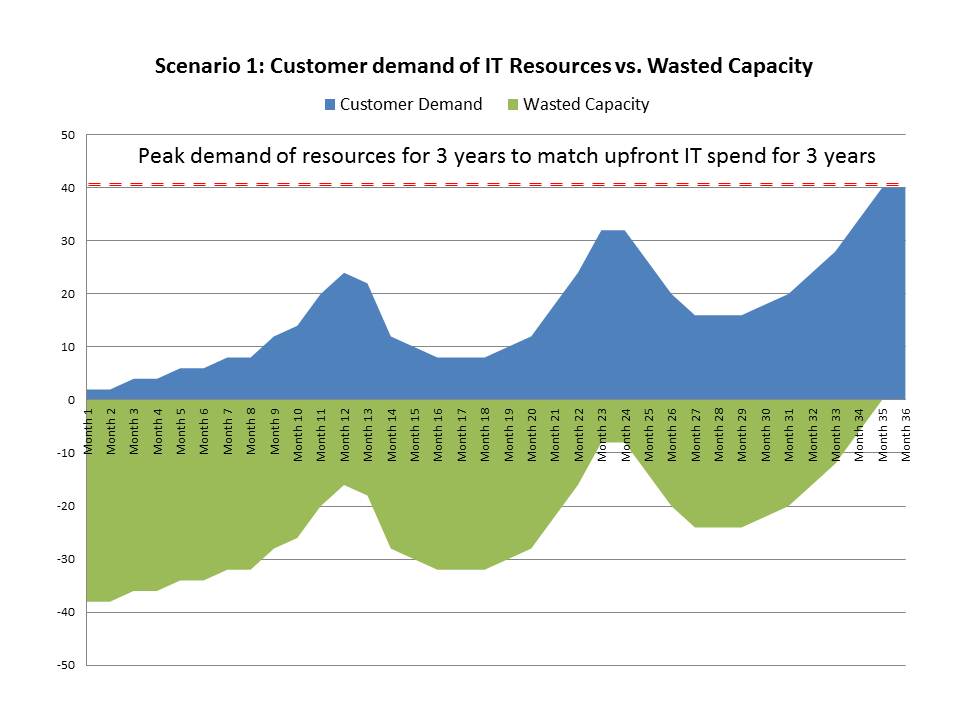
In the past when a business required IT resources like processing power and storage, the business purchased it for the longer term (3 – 5 years). The problem was the business was required to buy the processing and storage for peak times rather than average workload times. Most businesses have some sort of varying demands or cyclical nature to the demand for their products. There will be lean times and there will be times when excessive demand has to be met. In the past, buying IT resources was always a compromise between meeting excessive demand or letting business go and not meeting demand during excessive demand times. However, the way IT products were designed and the pricing of these resources was such that customers had to buy these for multiple years. This meant that you were paying for IT resources meant to meet peak demand for three years, while your peak demand might only be for 10 – 25% of the time. Take for example the retail industry. Their peak demand time starts Thanksgiving Day and ends Jan 1.I In the past they had to buy resources for the whole year or for 3-5 years. This meant that any given time, most IT workloads didn’t use the capacity of the IT infrastructure and resources deployed by IT.

See the graph below for Scenario 1. Month 1 is when the resources are bought and deployed. Month 36 is when they are end of life. Blue area shows actual demand for resources varying in a cyclical manner. A good way to show the waste is by considering the green area, which is a subtraction of the peak demand and the customer demand. Most of the time, the capacity is being wasted while it is already paid for. It also meant that at any given time IT resources were only used to a certain limited percentage. What a waste of money.
 

Wasted Capacity 1

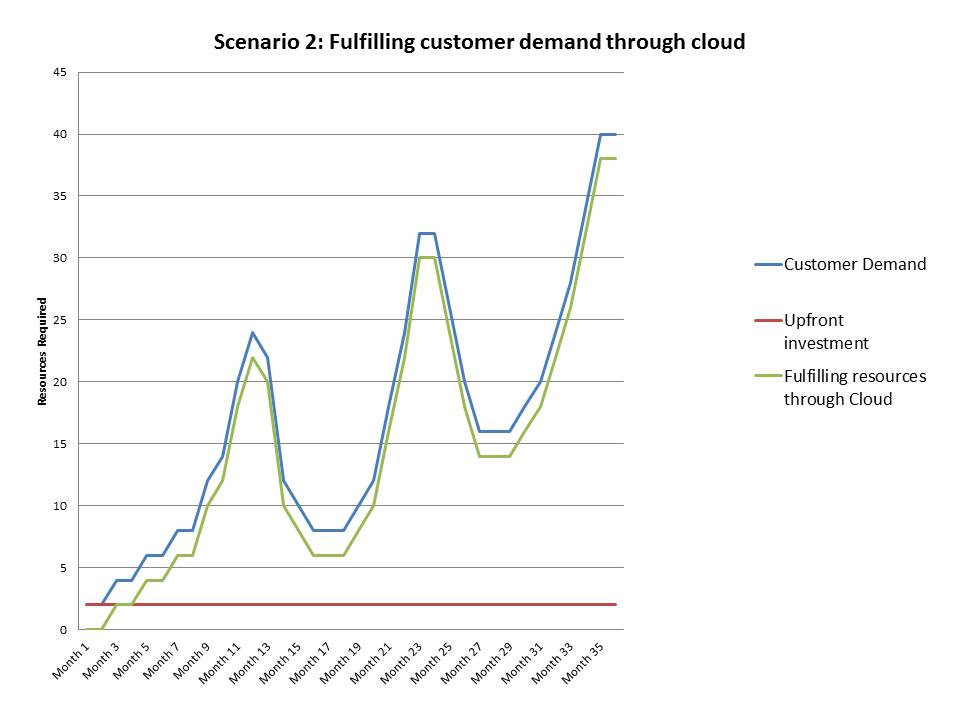
As processing power, storage and bandwidth charges dipped significantly and the use of internet grew, it was possible to deliver the processing power and resources required at peak time through the internet. Walk in the concept of cloud. Now you could afford to ship off your processing workload to a cloud-like environment. Take it a step further, why not have the entire applications sit in the cloud and just give your employees or customer access to it? In the cloud, you get to consume resources as and when you want it. Instead of buying everything up front, you get to consume the resources based on when you need them. You can ramp up your resources as and when required, meaning that you can actually match IT resources to the peaks and troughs in demand. Imagine the implications of that for a business, the cash flow impact, the ability to not worry about day-to-day IT issues. See the scenario 2 below. The upfront investment is limited to what you require to start out. Cloud capacity is used to match customer demand, thus reducing wastage of IT resources.
Matching CapacityFeel free to leave a comment 🙂

Next week:

Kitchen cloud, huh?

What is Cloud?

What is Cloud?

For a technical definition of cloud computing please see the National Institute of Science and Technology’s definition of Cloud Computing. In my opinion, Cloud is a term that refers to anything that is delivered “as a service”. The term “as a service” means you use it when you need it, but you don’t have to own it to use it. You probably also shouldn’t care about how it is delivered as long as it meets your requirements.

For the sake of simplicity, LinkedIn, Facebook, and Twitter are cloud services that provide interactions to their customers as and when required. Just 20 years ago, if you wanted to send your favorite pictures to grandma or to your friends, you had to buy a physical album, and mail it to them. Now this whole process can be turned around in seconds, and can be viewed all over the world. No more buying an album—Facebook provides that facility as and when you want it.

Impact on Business

Let’s translate this into a business scenario: cloud computing communication options like Webex, Slideshare, etc. have revolutionized business interaction. Now you can work from home, airport, hotel room, or coffee shop and interact with your customer. This changed the travel industry as more and more businesses required essential travel only. Just a few years ago, when you wanted to present an idea or pitch a sale to clients or management in different offices, you would have to travel around the country, schedule travel schedules and get everyone in the same room. Now all you have to do is make sure the calendars are aligned and the presentation can be worked on. Does that mean human interaction is dead? No! The level of the human interaction has significantly increased because of the increased frequency of online touch, and our ability to use services as and when you want them in the cloud. In these scenarios, cloud acts like a tool to increase human interaction. And like any tool, it is how you use it that makes the difference.

Real World Examples

For example: In 2009, a US based retail business customer came to the organization I was working for at the time with a problem: they faced major competition from online retailers and their in-store shopping model had taken a beating. To compete in their industry, they needed to completely revise how their customers were interacting with their organization and buying products. However, given their older systems and their past performance, they did not have the budget available to make a major upfront investment in building solutions to make their customer experience better, let alone retrain their staff to implement and manage those new solutions. And considering the timing: 2008-09 recession period, this was also not a good time to get managements / investors to make major investments in any business. We helped them deal with this situation by delivering to them a cloud based solution for e-commerce. We kept the upfront investments down by replacing this with on-going costs which matched their usage of resources and sales. Retailers in America love this because 3 months out of the 12, they have a great spike in sales and then most of the year, can be slim pickings at best. The impact was that retail business was able to survive the recession, able to come out leaner and meaner, and able to face competition from the online retailers in their industry.

In another case, we recently had a small business come to us that competes with the organizations much bigger in size and scale, in their industry. Their major issue was that they had no idea how well their discount campaigns worked. While larger companies can typically tell how their campaigns are working, this small organization didn’t know if the customers who were cashing in the discounts, were loyal and how quickly were they interacting with their organization due to these campaigns. This was primarily because the organization could not combine customer data (from loyalty email registrations) to data from sales. Plus the small business had a very limited technical staff, so deploying any IT solution to help combine the multiple data sources, was next to impossible. So we developed a cloud based solution where we managed the solution, and combined the data sources and delivered reporting on the impact of discount campaigns. In this case, we were managing the whole IT solution in the cloud, so that the customer could derive the business value, and limit their attention to business problems.

In the end, one of the lessons to be learned is that cloud computing a tool to solve problems. At the end of the day, it is a hammer, but it needs its nail: a business or personal problem, that must be solved to make it valuable.


Feel free to leave a comment 🙂

About Cloud Sommelier

I have worked in the cloud computing industry, in various positions, from Governance Consultant to Product / Program Manager to Sales, for the past 5 years. This also means very few people really understand what I do—and this includes my wife. I can’t recall exactly when this conversation happened, but I think it was during our drive to Orlando, Florida from Madison, Wisconsin. I guess long drives tend to bring out the questions.


My Wife: What exactly is your new job all about?

Myself: Well, I am responsible for cloud presales for my company in North America.

My wife: But what does it mean?

Myself: My company deals with data warehousing and big data technologies. Basically it is a way of collecting, organizing and analyzing information about our customers’ business so they can help grow their business. I help put this technology in the cloud, so that customers …

My wife: But why is the cloud part of your job?

Myself: Cloud is an easy way to deliver information. You can deliver it quickly. I basically combine different elements of the cloud to bring together a solution for the account teams and customers. I advise them on what things they should have in their cloud, what cloud solution would suit them and how it would work. And how these different aspects come together. What could suit their needs and wants, and help them run a cloud based solution …

My wife: So you are a Cloud Sommelier.

Myself: That’s one way to put it.


And that is how this idea started

What is this blog about?

This blog is about helping people understand what cloud is and how it affects our lives, from the point of view of someone who works with it every day. Over the years whenever I have had conversations about cloud computing, I have heard a lot of comments and questions: What exactly is the cloud? How safe is it? I don’t like the cloud so I don’t use it. It’s not for my business (big or small). My focus is to address a lot of these issues and considerations around cloud computing with this blog. I would like to hear from readers about what you want to read around the topic of cloud. I will try to share with you with my personal advice, opinions and my experiences, and I would love to hear yours.

In addition, I will welcome guest bloggers on a semi-regular basis to express their opinion about cloud computing topics. I will rely on people I know in the industry to express about their thoughts about cloud computing or any topic they want to bring to the readers.

A special thanks goes out to my wife Nikki for the motivation, and my friend and writer extraordinaire Laura Schaefer for editing my blog! She is a co-founder of wordchum, writes travel books for kids and the author of The Teashop Girls and its sequel The Secret Ingredient (out now!).


Feel free to leave a comment 🙂