I am going to start recording these, because these are awesome statements:
“In cloud, everyone wants the sausage, but nobody wants to know how the sausage is made”

I am going to start recording these, because these are awesome statements:
“In cloud, everyone wants the sausage, but nobody wants to know how the sausage is made”
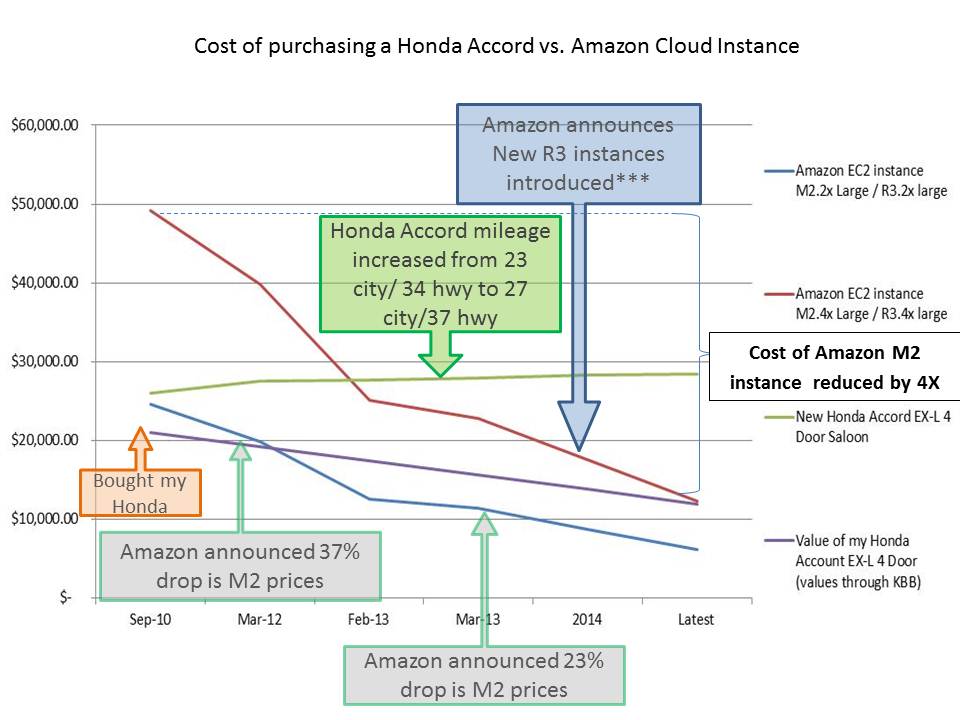
Latest edition of the Cloud Sommelier blog. Thanks to my friends Ali Pasha and Laura Schaefer for their help. I compared the costs of cloud computing over past years to the cost buying a Honda Accord. For more details, see the link below:
I love this debate. Imagine if this was the other way around. If a European (or for that matter any other country) asked for US based data. In my opinion, this could have terrible precedence.
Microsoft tells US: The world’s servers are not yours for the taking
http://arstechnica.com/tech-policy/2014/12/microsoft-tells-us-the-worlds-servers-are-not-yours-for-the-taking/?utm_source=feedburner&utm_medium=feed&utm_campaign=Feed%3A+arstechnica%2Findex+%28Ars+Technica+-+All+content%29
Great work by the writer on this one.
 With recent cloud-related security concerns, this topic has become a big conversation piece. I recently had a chance to talk to a friend, Jeremy Guthrie, regarding Cloud Security and how people should approach it. Jeremy has been in the Information Technology / Internet Service Provider business for 23 years, concentrating on networking and security architecture. Side note: I was tempted to include a face-covered picture of Jeremy but unfortunately no cloak and dagger stuff here, just two friends talking. 🙂 Thank you Jeremy!
Here is the synopsis of the conversation, in a two-part blog:
Let’s start with how to think about Cloud-based security for an average cloud user:
Jeremy: As a user, you have to start thinking about where your data is going. You might not need to know the exact physical address, but rather, who is the data going to? What data is going there? Conceptualize whether or not you have control over the data / information you are placing in the cloud. An example: Recently a cloud-based storage / file sharing service, which is used by corporate and individual users, blocked access to sharing of MP3s from individual customers’ accounts. Interestingly these were blocked due to compliance to Digital Millennium Copyright Act (DMCA1). So in this case, the question is who is in really in control of the files?
For the record, neither the writer of the blog or Jeremy Guthrie is arguing for or against the actions of the storage provider or DMCA.
My thoughts: Typically we tend to think of cloud-based storage as an extension of our laptop or device that resides in our physical premises. In which case, typically no one can impose any restrictions on them without either a court order. However in this case, the 3rd party is placing the restrictions in compliance of a legal order.
So what should an average cloud user do?
Jeremy: It is easy to be lazy about the information you give out online and in the cloud. Track what data / information you give about yourself and where. Imagine no data you give out is trivial. Maintain separate passwords for your different online accounts and make sure you have system to store these. If something bad happens, the first question will always be “What did I have there?” If you cannot answer that question, then it is harder to come to a reasonable response. Not every data loss is the end
of the world but you need to know your footprint.
Where can I store my various passwords?
Jeremy: 1Passwordis a good tool. (Here is a link to 1Password: https://agilebits.com/onepassword).
It’s about making you a harder and smaller target. If someone is hell-bent on stealing your identity, they will be able to steal it after making some effort. However the purpose of protecting your identity is to make yourself not stand out and not be an advertised target. Protecting yourself online is basically about reducing the risk of becoming a target. As with any risks, there are trade-offs.
What can you do reduce the risk?
(You can read the rest of this next week …. 🙂
Dear readers,
It has been 4 weeks since I put something here. Update: I am working on a couple of blogs side by side related to Cloud Security. In the meanwhile, my friend Marc Clark wrote a really good blog about Analytics in the cloud and the utility of cloud to solve problems.
http://blogs.teradata.com/data-points/the-cloud-isnt-a-silver-bullet-for-analytics/
Next week:
Cloud Security with Jeremy Guthrie!
I would like to get back to the “as a service” discussion from a previous post. Recently I watched an episode of Travel Channel’s Bizarre Foods America. The episode centered on NYC and late night food and culinary practices in NYC. Of specific interest to me was the story of Hana Kitchens. As Andrew Zimmerman puts it on their website, “These are the people that are going to be the titans of the food industry in the years to come.” Well then, what does Hana kitchen provide? According to their website: “At Hana Kitchens it is our mission to be the resource providing the means and the support and business advice to culinary entrepreneurs and to be a collective that has the tools and equipment to offer both apprentice and professional alike.” http://www.hanakitchens.com/about/
Basically, they provide advice and industrial styled kitchen space and equipment on rent on an hourly basis to chefs and businesses that want to produce culinary delights.
Let’s think of a scenario: You are a patisserie chef, who is just starting out in NYC, wanting to start a business making pastries for the local bakeries. You just graduated from a fine culinary school, you have the talent and the knowledge of how to cook, and have an idea of products you want to produce on daily basis. What you probably don’t have is cash or funds! As a patisserie chef, what are the activities that you should be spending time on? Should it be: refining your recipes, trying new recipes, making a perfect batch of goodies, gaining new knowledge of food, learning new tricks of the trade? Or should it be paying individual bills for the kitchen like electricity, gas, etc., managing the equipment, and, if anything breaks down with the equipment, fixing it? Isn’t that a waste of chef’s brain and time? This is what Gartner or other advisory services call “concentrating on your competitive advantage.” A chef’s competitive advantage is recipes, his / her knowledge of the food and presentation of the food. Not the kitchen equipment and oven. Yes, good tools definitely help in the process, but if your recipes are not great and your knowledge of the food is lacking, then great equipment can’t replace it. What are the first major costs you have to incur when you start the business? You have to basically rent a kitchen space and buy all the equipment. This means, whether you are working or not producing pastries, you own that piece of equipment. It is not being used. Plus to own all of this equipment, you will probably have to ask a bank for money or use some of your own. if you are rich enough or have money lying around, more power to you. However, if you don’t, like most new small businesses don’t, then aligning your sales and cash flow to the use of your resources is very important. You can’t tie up cash in equipment that is not being used a lot of the time.
Step in Hana Kitchen. They allow you to rent kitchens for 6 to 8 hour shifts that allows you to produce a batch of goodies to send out and sell to bakeries that day. This means you are not using your money to invest in this business, but actually getting your customers to pay for kitchen. Plus someone else is managing the kitchen, keeping it up and running for you. You don’t have to manage it, pay individual bills, and maintain the equipment. You get to concentrate on refining your recipes and building your competitive advantage. Keep in mind, Hana kitchen has to provide a certain level of good equipment. It can’t be terrible experience for a chef.
Thus Hana kitchen is a Kitchen Cloud!
So what does it teach a small business owner? Small business owners have to traditionally do a lot of the stuff themselves. Cloud based tools just help you perform the tasks automatically, without reinventing the wheel. This helps you to concentrate on creating competitive advantage and aligning your expenses to your revenue. The competitive advantage is very important because almost always a small business is competing with large businesses for customer attention.
There are multiple cloud services to help perform different business functions. If you need to produce documents and balance sheets, use Google Docs (free) or Office 365. Use Dropbox / Box.com / Google drive / Microsoft OneDrive (all of them have a limited free services) to exchange documents with your customers rather than buying your own storage and sharing setup. Here is a link to some small business storage services, where you can back up and store a lot of the information: http://business-cloud-storage-services.toptenreviews.com/
There are ton of tools like Intuit Quickbooks / Fresh books / Intuit payroll etc. to help you manage the finances, do payroll, manage expenses, etc. If you need processing power, use a cloud provider like Amazon or Rackspace or Microsoft rather than buying servers. Use Adobe Connect, Webex or GotoMeeting for meeting with your customers. Use Gliffy for making diagrams like org charts, floor plans, etc. As you grow, use Salesforce.com for your business. For accepting payments, use PayPal or Square on your phone as and when you can.
List of tools:
Here is a slightly older, albeit a good starting list of tools: http://www.pcmag.com/article2/0,2817,2361500,00.asp
The basic idea is that there are a lot of tasks involved in support functions like finance, documentation, accounting, storage, etc. that are required in running a small business. Large business can afford to perform these functions on their own, and with a large support staff. If you’re competing with them, don’t try to do it all yourself. Try to compete based on your competitive advantage, and for support tasks that don’t add to your competitive advantage, use a cloud based tools.
What is the advantage? Cloud services are normally priced by consumption like resource or per user, so you can align them to your cash flow and sales. The image below helps to summarize these facts and puts some items really well. Look at the numbers: 98% have technology as a success factor, but 42% do NOT have an IT department. I think the majority of the rest 58% probably have a small 1- 5 people department. This is where it is essential to use cloud services to your gain.

Eerily similar to the major cloud providers’ growth strategy, Hana Kitchens is looking to establish itself on both coasts of the continental US. Their next destination is LA. Given the way they are able to breed new culinary ideas coming out of their kitchens, I think they will be titans of the food industry.
There is a similar communal kitchen here in Madison WI called FEED Kitchens, but it has a non-profit bent: http://feedkitchens.org/
 cloudsommelier