
To understand the evolution of cloud computing, we must simplify the definition of cloud computing. According to PC Magazine, “In the simplest terms, cloud computing means storing and accessing data and programs over the Internet instead of your computer’s hard drive. The cloud is just a metaphor for the Internet. It goes back to the days of flowcharts and presentations that would represent the gigantic server-farm infrastructure of the Internet as nothing but a puffy, white cumulonimbus cloud, accepting connections and doling out information as it floats.”
One of my favorite parts of this definition is that “cloud is a metaphor for the internet.” Cloud computing really embraced the concept of internet and took it to another level. As the price of internet (processing ability and space or storage) dropped because of technological advances, it became easier and more affordable to deliver applications and services through the cloud. For example, twenty years ago, if you loved your music and wanted to have a big collection, you had to set up a music library in your home with bunch of CDs in a big stack that would use up shelf space in your place. Now you can have all your music in the iTunes cloud delivered as a music service and access it from your phone. No more need for racks and racks of CDs/ cassettes / tracks. This is because it became very cheap for companies to store tons of data and customers got easy, affordable internet access to download the music as and when it was required.
Let’s do some math:
A typical song can vary between 1.5 megabytes to 5 megabytes in size (1 byte = 8 bits). Look at the graph below. The cost of internet is declining at an 18% rate, while bandwidth capacity is growing at 32%. When I started using the internet, I started out with a 2400bits per second modem. At this rate it would take me about 4 hours to download a song. I was super excited when I got to break the 9.6 kilobits per second barrier with a brand new modem. Today I have 30 million bits per sec coming to my place. At this speed, I can download a song in less than 30 seconds.

What does all of this mean? Numbers sound great, but the impact on our lives is significant. All of the reduced time in downloading meant that if I wanted to listen to a song right now, I could download it on my phone, as and when required. It means Apple can provide the ultimate music experience of delivering you a product as and when you want it.
Imagination or Internet running wild
10 years ago, most people couldn’t fathom having all their music on their phone because it took too much time to download. Today not only can you download the music you want on your phone but you can see movies (Netflix), podcasts and sports (NFL RedZone by Verizon) at today’s internet speeds. Now imagine if Google Fiber came to your house. As described by Google:
“Google Fiber will provide an Internet connection speed of one gigabit per second (1,000 Mbit/s) for both download and upload which is roughly 100 times faster access than what most Americans have. Google Fiber says its service allows for the download of a full movie in less than two minutes.”
The Guardian recently published a great article on the effect of the 1 gig internet coming to small town America. Way to go, Chattanooga!!
What can you do with that sort of connectivity? What opportunities come to your mind?
Taking this to the business level:
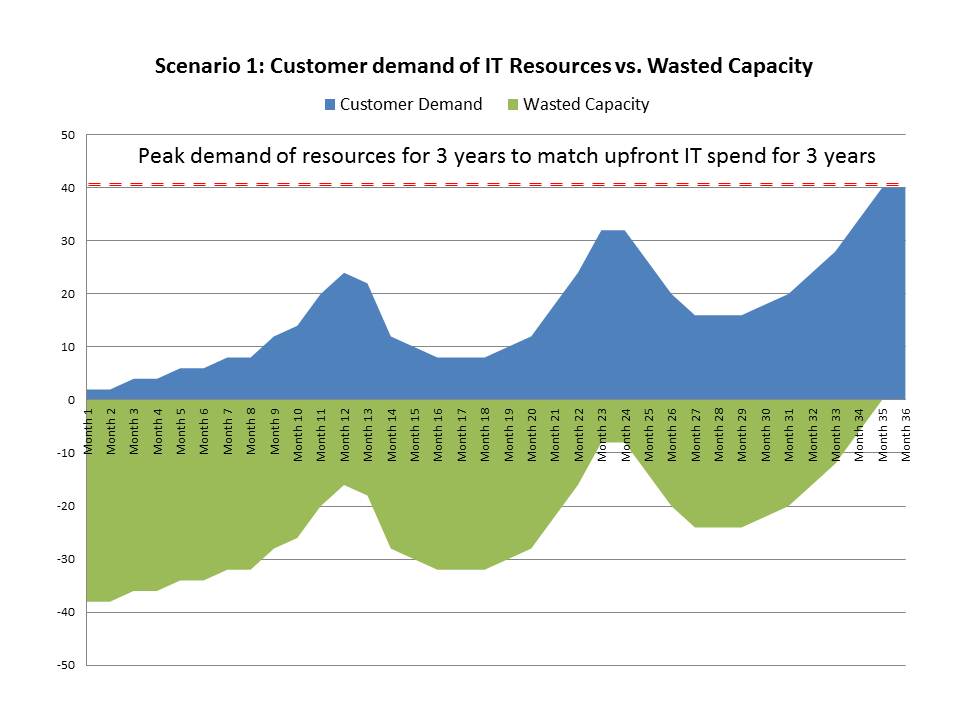
In the past when a business required IT resources like processing power and storage, the business purchased it for the longer term (3 – 5 years). The problem was the business was required to buy the processing and storage for peak times rather than average workload times. Most businesses have some sort of varying demands or cyclical nature to the demand for their products. There will be lean times and there will be times when excessive demand has to be met. In the past, buying IT resources was always a compromise between meeting excessive demand or letting business go and not meeting demand during excessive demand times. However, the way IT products were designed and the pricing of these resources was such that customers had to buy these for multiple years. This meant that you were paying for IT resources meant to meet peak demand for three years, while your peak demand might only be for 10 – 25% of the time. Take for example the retail industry. Their peak demand time starts Thanksgiving Day and ends Jan 1.I In the past they had to buy resources for the whole year or for 3-5 years. This meant that any given time, most IT workloads didn’t use the capacity of the IT infrastructure and resources deployed by IT.
See the graph below for Scenario 1. Month 1 is when the resources are bought and deployed. Month 36 is when they are end of life. Blue area shows actual demand for resources varying in a cyclical manner. A good way to show the waste is by considering the green area, which is a subtraction of the peak demand and the customer demand. Most of the time, the capacity is being wasted while it is already paid for. It also meant that at any given time IT resources were only used to a certain limited percentage. What a waste of money.
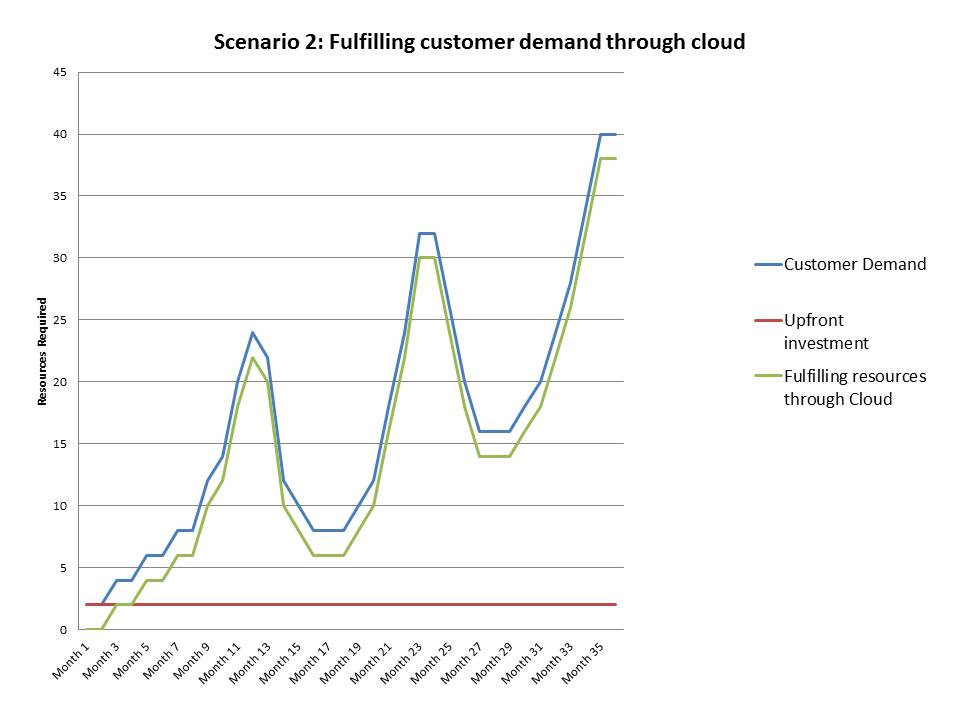
As processing power, storage and bandwidth charges dipped significantly and the use of internet grew, it was possible to deliver the processing power and resources required at peak time through the internet. Walk in the concept of cloud. Now you could afford to ship off your processing workload to a cloud-like environment. Take it a step further, why not have the entire applications sit in the cloud and just give your employees or customer access to it? In the cloud, you get to consume resources as and when you want it. Instead of buying everything up front, you get to consume the resources based on when you need them. You can ramp up your resources as and when required, meaning that you can actually match IT resources to the peaks and troughs in demand. Imagine the implications of that for a business, the cash flow impact, the ability to not worry about day-to-day IT issues. See the scenario 2 below. The upfront investment is limited to what you require to start out. Cloud capacity is used to match customer demand, thus reducing wastage of IT resources.
 Feel free to leave a comment 🙂
Next week:
Kitchen cloud, huh?
 cloudsommelier